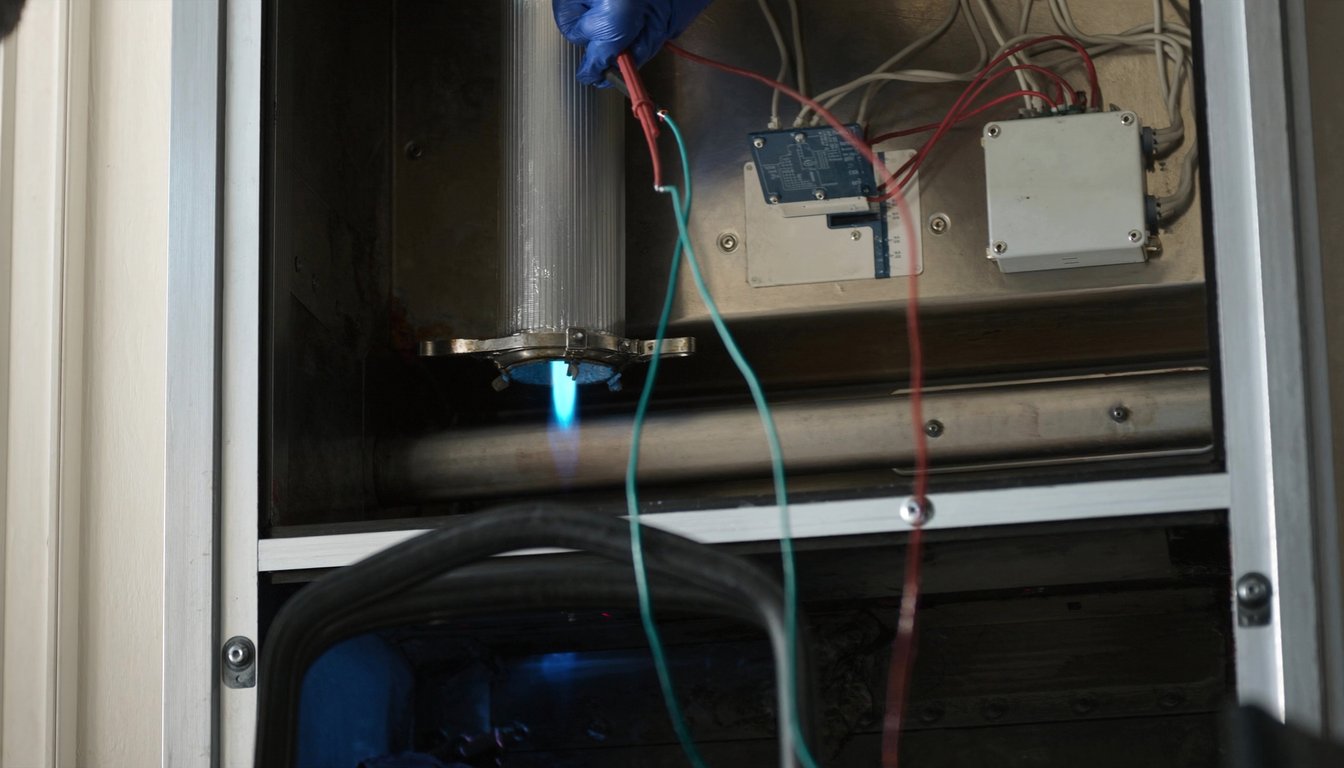
San Bernardino furnace work has a more concentrated heat-exchanger-failure population than other IE cities for two specific reasons. First, the city's housing stock is unusually mid-century — about 38% of homes were built between 1945 and 1975 (highest mid-century concentration of any city we serve), which means a large cohort of original 1990s-era replacement furnaces are now hitting the 25-30 year mark simultaneously. Second, the elderly demographic in Arrowhead, North Park, and the medical-area neighborhoods makes CO safety non-negotiable on every diagnostic — we run combustion-analyzer readings even when the customer asks for "just an igniter swap." Cracked heat exchangers in this housing cohort often show up as elevated ambient CO at the supply register before the homeowner notices anything. We've pulled CO readings above 35 ppm on multi-decade furnaces during what the customer thought was a routine "no heat" call.
Foothill-elevation neighborhoods (Verdemont, Del Rosa, Highland Avenue corridor near the National Forest boundary) sit several hundred feet higher than the central valley and run consistently colder overnight, which means furnaces in those neighborhoods accumulate more cumulative cycle hours per winter than valley addresses. Different wear pattern: igniters fail more often, blower bearings wear faster, control boards see more thermal stress.